Start here
This is a thought experiment about choosing to live without oil combustion, and without the advanced forms of energy that could replace it, in order to return to a more natural way of life. Not solar panels instead of gasoline. Not a cleaner machine. No machine. Wood, muscle, wind, water, and sun, the way a farmer in 1750 used them, and the choice, made again every year, not to go back.
I did not write it because I think we should tear down the refinery tomorrow. I wrote it because we have stopped asking a question that every people before us had to ask, and a few still do: what is this technology allowed to do to us? We only ask what it does for us. That is a different question, and answering only that one is how we got here.
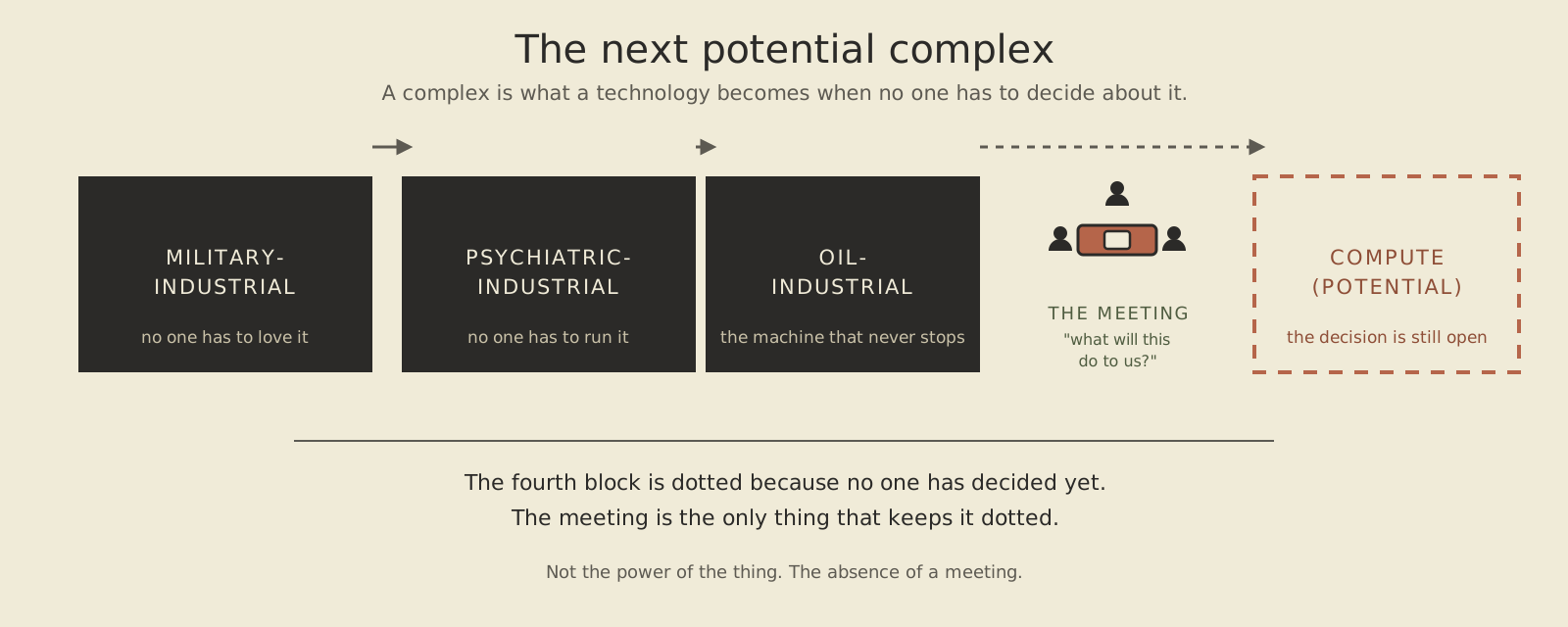
A complex is what a technology becomes when no one has to decide about it. We have a military-industrial complex and a psychiatric-industrial complex, and underneath both, older and larger, the oil-industrial complex that built the machine this essay takes apart. The next potential complex is assembling itself now, on your meter and your water: compute. AI. I say potential because the decision about it is still open, and an open decision is the only reason to write. So the question in the subtitle is the question of the piece. What is an individual to learn, and what is a republic to learn, from the peoples who take their time deciding about a technology, before the next complex settles in and makes the deciding unnecessary again?
The machine that never stops
Here is what I mean by "here."
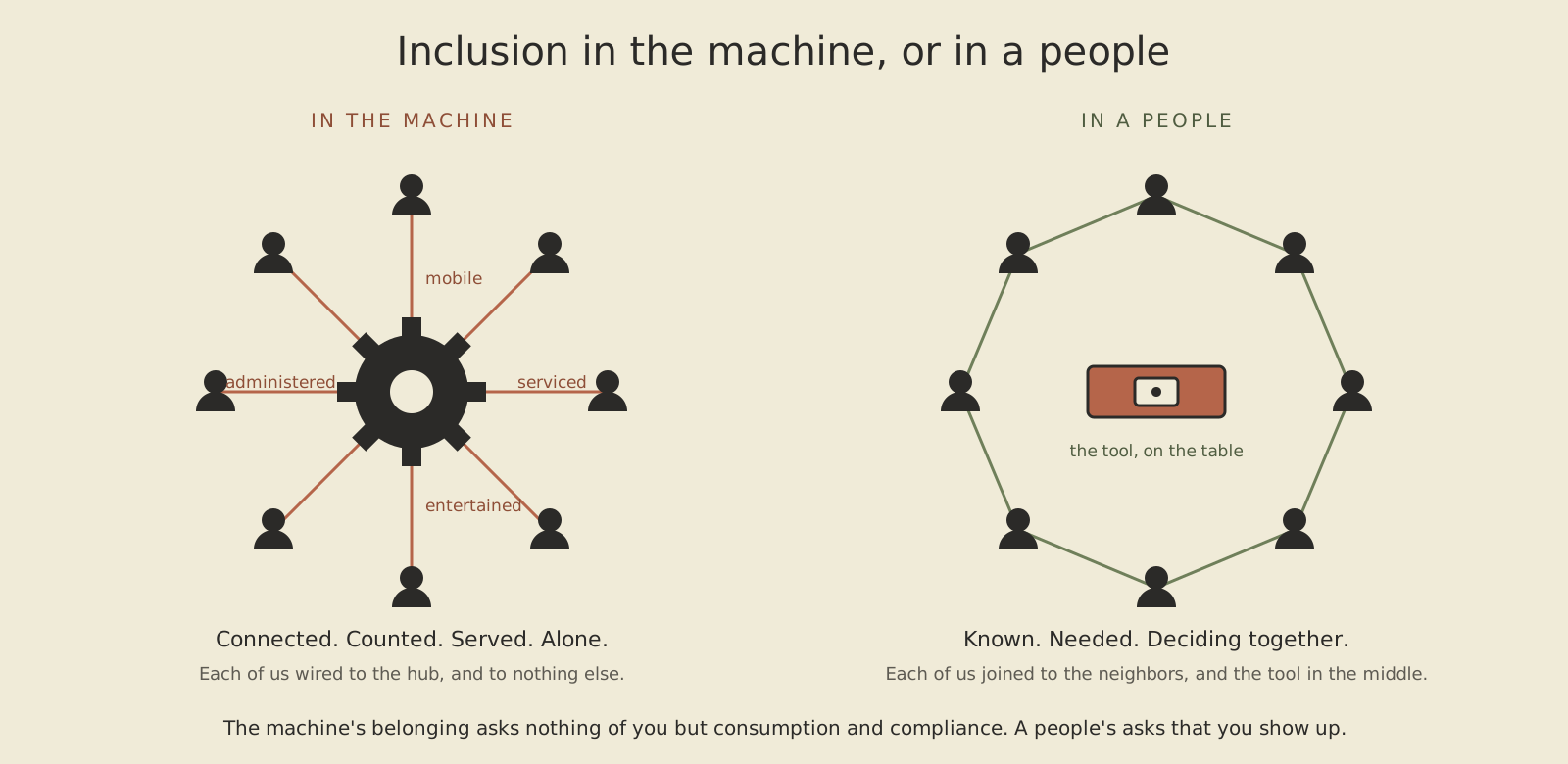
Oil built a machine. Cheap energy became the oil-industrial complex, and the complex became the shape of our lives: the highway, the subdivision, the supermarket, the office park, the feed on the screen, the agency, the form. It gives every one of us the same roads, the same brands, the same screens, and the same paperwork, and it tells us this is inclusion. We are connected. We are counted. We are served.
It is inclusion in the machine, not in a people. Real belonging is being needed by people who know you. The machine's belonging asks nothing of you but consumption and compliance, and it can be cancelled by either side at any time.
And it never stops. It cannot. The refinery, the trucking fleet, the mortgage on the subdivision, and the budget of the agency all need next year's throughput to be bigger than this year's, so it keeps pulling. I want to be exact about what the pulling does, because it is easy to blame the machine for more than it owns.
Divorce, estrangement, and the growth of government have many causes, and most of them are not oil. The law changed. The churches emptied. Wages and women's work changed. People chose things people had always wanted to choose. I am not going to pretend the machine did all that. What the machine did is narrower, and I think more important: it removed the friction that used to make people stay, ask, and answer. The job pulls the son across the country from his father, and nothing pulls back. The car lets a marriage end without either person having to face the neighbors, and no one has to be faced. The school, the clinic, the court, and the caseworker step in where the family and the congregation used to stand, and once they step in they do not step out, because no one has to decide that they should. Something like four in ten marriages end in divorce. Roughly one in four Americans reports being estranged from a family member. A Surgeon General has declared loneliness an epidemic. Meanwhile the paperwork grows every year in every direction, and it always has a reason.
I do not think the machine caused those things. I think it made them costless, and that is the one thing it unquestionably owns: nobody had to decide. No one designed the machine and no one has to run it. It only had to make each of us individually mobile, individually serviced, individually entertained, and individually administered, and the rest followed on its own, because the question that used to stand between a people and a new tool, what will this do to us, was never asked, and no one noticed it was missing.
So I asked it. What if the machine went away, and we chose not to bring it back?
The rules of the experiment
To think clearly you have to fix the scenario and stop arguing with it, so here it is, taken as given.
Fossil combustion ends. All of it: oil, coal, and gas, over about ten years, fast enough that people who are old now remember filling a tank. Nothing replaces it. No battery, no reactor, no fusion. Energy goes back to wood, muscle, wind, water, and sun. We stand thirty-five years later. The oil is still in the ground. Someone could go get it. No one does.
That last line is the whole point, and I will come back to it. First, the hard part.
First, the count
The first honest thing to say is that there are fewer people, and no one is sure how many.
About half the nitrogen in the protein of your body came through a fertilizer plant that runs on natural gas. Take that away and you take away, by the usual estimate, the food for about half of eight billion people. Diesel moves nearly all the rest: tractors, trucks, ships, the cold chain. We are, one step removed, eating oil.
So the ten years of loss are ten years of hunger, and it should be said plainly. Cities cannot feed themselves; they never could. People walk out along the highways that used to feed them, and not all of them arrive, and the ground cannot take all who do. Most of the dying is by the things that always killed the poor: hunger, cold, dysentery, childbirth, infected wounds. The number is large and unknowable. To pretend it could not happen is a comfort we do not get. To call it a cleansing is a cruelty I will not commit.
What the land feeds a generation later is a guess with rough edges. Farming without fossil fuel carried under a billion people in 1800, but those farmers did not know what we know: rotations, bred seed, germ theory, how to keep soil on a hill. Estimates for organic, muscle-powered farming with modern knowledge run from two to four billion. Call it two to three, concentrated where rain and soil are good, and most of them farming, eight in ten, as it was almost everywhere before coal.
Two things follow. The map redraws itself around food and firewood, not ports and pipelines. And the people who are alive are, disproportionately, the ones who could grow food, or lived near those who could, and cooperated well enough to hold ground. That fact matters for everything about how they decide.
Does the earth heal? Three clocks
It depends which clock you read.
The fast clock: air, rivers, noise, wildlife. When cars stopped for a few weeks in 2020, the air over northern Italy and Wuhan cleared by a third to a half. Here it clears and stays clear; within ten years "air quality" is a phrase nobody uses. The dead zone at the mouth of the Mississippi was mostly fertilizer, and the fertilizer stops. Noise stops the week the traffic does, and it is the thing the old people talk about most. Wildlife moves at the speed of animal generations, which is fast: the empty zone around Chernobyl filled with wolves, elk, and lynx within a few decades, and the same thing happens in every emptied suburb. Deer become the great pest of the new farms. Wolves follow them.
The slow clock: carbon, oceans, soil. When emissions stop, warming stops rising, but it does not go back down; the models mostly agree it holds. About a quarter of the carbon we already burned stays in the air for thousands of years. So the world is a little warmer than the day the machine stopped, and stays there for centuries. The sea keeps rising slowly from heat already stored in the deep ocean. Ocean chemistry recovers on the same slow schedule. Soil is quicker but not quick: a tired field rebuilds in a decade or two, but a hillside that lost its topsoil to the plow lost a thousand years, and gets it back at about that rate.
The broken clock: extinction. The passenger pigeon does not come back. Neither does anything else we lost. Whatever "healing" means, it does not mean that.
The wood trap
Now the part the romantics skip. Fewer people is not the same as gentler people. Two or three billion humans heating with wood is an enormous appetite for forest. England turned to coal in the 1600s partly because London had run out of firewood within hauling distance. And the smoke is not free: in our own world about 2.3 billion people still cook on wood, dung, or charcoal, and the smoke kills roughly three million of them a year, mostly women and children.
So every city is cleaner. Whether the world as a whole becomes a recovering biosphere or a stripped one is decided valley by valley, by three things: whether people know how to coppice and rotate a woodlot, whether they build stoves that burn hot and vent outside instead of open hearths, and whether they make rules about the forest and keep them. Japan under the Tokugawa is the standing proof it can go either way. Having nearly deforested itself by 1700, Japan spent the next century building forest law and village-managed woodlots, and held it for two hundred years. The difference was never the amount of wood. It was the governance of the wood. Hold that thought. It comes back.
What the land looks like
Nothing is shaped around the car anymore. The interstates go brushy within a few years and become raised causeways that people walk because they are straight and drain well. A house twenty minutes' drive from anything is five hours' walk from anything, and most of them stand empty. The parking lots, and there are by some estimates more parking spaces in this country than people, become the market squares and the town gardens. The size of a day is again a day's walk, ten or fifteen miles out and back, and market towns sit at that spacing along the rivers, as they did in 1750. A barrel of anything moves by water or mostly does not move. Horses, oxen, and mules do the rest.
The ladder of needs
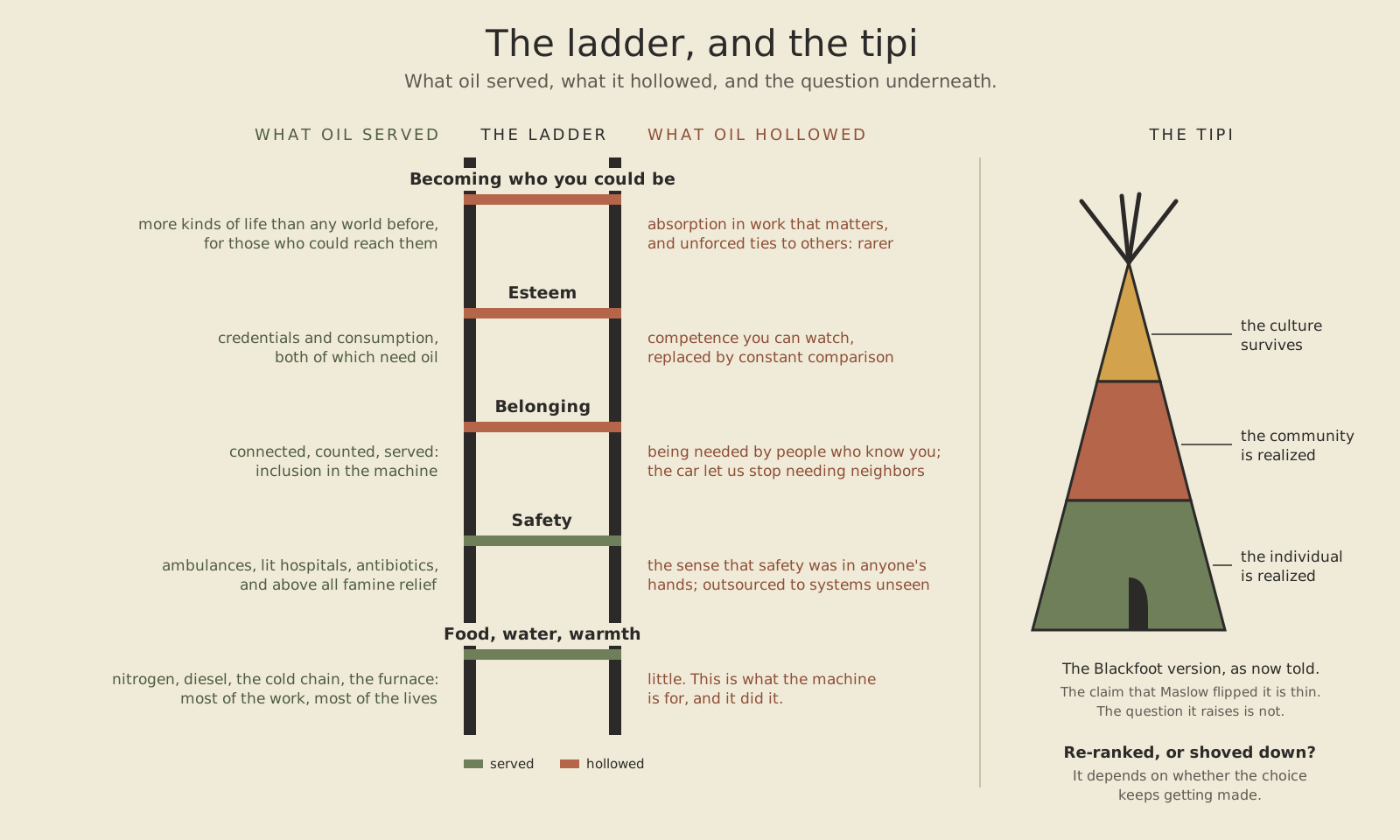
In 1943 Abraham Maslow proposed that human needs come in an order: food and warmth first, then safety, then belonging, then esteem, then becoming who you could be. He never drew a pyramid; textbook writers added that in the 1960s and made a tentative idea look like a law. Used as a lens rather than a law, though, it is a good way to take inventory of what oil actually did to us.
Food, water, warmth. This is where oil did the most work and where its loss costs the most lives. Nitrogen, diesel, the cold chain, the furnace.
Safety. Ambulances, lit hospitals, antibiotics by the ton, and above all famine relief: trucks and ships made a local crop failure a local problem instead of a local catastrophe. That is real, and it is gone. What oil quietly eroded here was the sense that your safety was in anyone's hands at all. It was outsourced to systems no one could see. In the world without oil, safety is granary, woodpile, and neighbors. Visible, frightening, and shared.
Belonging. This is the rung the machine is worst at, and the one the world without oil does well almost by accident. The car was, among other things, a machine for not needing your neighbors; Robert Putnam found that every ten minutes of commuting cut civic involvement by about a tenth. In the world without oil you are known. You cannot not be. Threshing, wood-cutting, barn-raising, funeral, market: none of it can be done alone. Whether that is belonging or surveillance depends a good deal on who you are, and I will be honest about that.
Esteem. The machine runs esteem on consumption and credentials, both of which need oil, and it breeds constant comparison. Without it, esteem runs on competence you can watch: who splits wood clean, whose fences hold, who can set a bone. More available, and narrower. There is no esteem for a good software engineer, because there is no software.
Becoming who you could be. The machine offers more kinds of life than any world before it, to those with the money and mobility to reach them. The world without oil offers fewer. But Maslow's own examples of fully realized people were not defined by their range of options. They were defined by absorption in work they thought mattered and by unforced ties to other people. Both are more common in the world without oil. And more people never get the chance to find out, because they die younger.
There is a question hiding under the ladder. In 1938 Maslow spent six weeks with the Blackfoot in Alberta and came away shaken by how emotionally secure the people were, and by the giveaway ceremonies in which standing came from what you gave away. A claim has spread in recent years, mostly from Blackfoot and other Indigenous scholars, that Maslow took the Blackfoot's own model, the individual at the base of a tipi, the community above, and the survival of the culture at the top, and flipped it into the individualist pyramid we know. The documentation for that is thin. But the question it raises is the right one: is a people who stays off oil a people who has re-ranked its needs, putting the survival of the community above the enlargement of the individual? Or a people who has been shoved to the bottom of the ladder and is making a virtue of the fall?
Here is the answer I have come to. It depends on whether the choice keeps getting made, or was made once.
Many nations, one question
There are hundreds of nations on this continent, and folding them into one figure who was "closer to nature" is the first mistake. The Haudenosaunee, the Diné, the Blackfoot, the Hopi, the Comanche, and the Yup'ik differ from each other as much as Portugal does from Finland. Some farmed and built cities; Cahokia, near St. Louis, was as large as London around the year 1100. Some fished from permanent villages of great stored wealth. Some, within a few generations of the horse's arrival, became the finest light cavalry on the continent. These were sophisticated economies. What they were not was fossil-fueled, and the useful question is not what they knew about nature but how they decided about tools.
Three ideas travel best. Seventh-generation thinking, from the Haudenosaunee: weigh a decision by its effect on people seven generations out. Reciprocity, which the Potawatomi botanist Robin Wall Kimmerer describes as the Honorable Harvest: take only what you need, ask first, never take the first or the last, give something back. And land as relative rather than resource, a claim about kinship rather than a feeling. All three are rules about who is in the room when a decision is made: future people, and the non-human ones.
The record of actual technology decisions is even more useful, because it kills the noble-savage myth. Plains nations took the horse and remade themselves around it inside a century. Nearly everyone took metal knives and pots the moment they were offered. These were not people afraid of tools. But there were refusals, and they were organized. Neolin, the Delaware prophet, preached in the 1760s that his people give up European trade goods and alcohol. Handsome Lake, the Seneca prophet, gave his people a code in 1799 that banned alcohol, took on certain European farming methods, and kept the ceremonies; the Longhouse religion built on it is practiced still. Each was a community answering the same question out loud: which of these things do we take, which do we refuse, and what does each do to us?
What we can learn from that is the shape of the question. What we cannot borrow is the room. Those decisions were made inside kinship, language, ceremony, and a long relationship to one place. The mechanism was the relationships, and it does not lift out and bolt onto a subdivision.
The Ordnung
If you want to watch a people deliberately not using something they could easily have, drive to Lancaster County. About four hundred thousand Amish live in North America, and their way of deciding about tools is the most fully worked-out example of chosen non-use the industrial world has.
Here is how it works. The unit is the church district, twenty-five to forty families. Each district has its Ordnung, an unwritten set of rules on dress, work, and technology, which the members reaffirm twice a year at a meeting held before communion. A new tool comes before that meeting and before the bishop and ministers, and the question asked of it is not "is it useful?" but something closer to "will this pull us apart or hold us together?" Will it let a family do alone what they now do with neighbors? Will it bring the world into the house? Grid electricity was refused because the wire runs to the world. The car was refused not because it goes fast but because it lets you leave.
Now the honest part, because the Amish answer was never simply no. Amish shops in Lancaster run on diesel engines driving air compressors and hydraulic pumps. Kitchens have propane refrigerators. Farmers pull a gasoline engine on a cart behind the horses to run the baler. Families hire "English" drivers to reach the doctor and the wedding two counties over. The line is drawn with great care, and it is drawn through the middle of the oil economy, not around it. Their hospitals are ours. Their non-use rests on a world of use.
Their health numbers get cited a lot, and they deserve a skeptic. One study put Amish men at eighteen thousand steps a day with obesity in the low single digits, and older studies found mood disorders at a fraction of the general rate. But the samples were small, the people who stayed Amish were selected over generations for fitting Amish life, a community that treats despair as a failing of faith underreports it, and the same closed gene pool gave the Amish some of the world's highest rates of certain recessive diseases, managed by a clinic that runs on the outside world's chemistry. The honest summary: daily labor, no tobacco, little alcohol, and dense community appear to be good for the body, and we know this mostly from a population with modern medicine at the end of a hired car ride.
And the costs of the system are the system. Schooling ends at eighth grade. Women's roles are fixed. Exit is expensive by design. In a world with no outside to lease from, and no outside for the dissenter to leave to, the district becomes the state, and the person who says no has nowhere to go but the next valley or the woods. That is the sharpest cost of chosen non-use at scale, and no admiration for the Amish should soften it.
Notice what that objection actually proves, because it is the finding of this essay and not a hole in it. The Amish meeting works because there is an outside: an English world that supplies the hospital, the road, and the door. Take the outside away and the meeting turns into a cage. So the lesson is not that the Amish are a model you can copy. It is that any people who wants to run the meeting has to build the outside as well, and the second half of this essay is about what building it means.
The honest cost
I promised not to romanticize, so here is the ledger, and both sides are true.
Children die. Before antibiotics and clean water, between a third and half of children died before age five. The machine brought that below four in a hundred worldwide. In the world without oil the number climbs back, not all the way, because germ theory, soap, boiled water, and the oldest vaccines survive, but a long way. Antibiotics at scale needed industrial chemistry; without it a wound turns, a fever comes, and a mother sits up and waits. Surgery without antibiotics is a coin flip. Every measure of length of life is worse.
Famine relief. Wherever a harvest fails, and harvests fail, there is no fleet of trucks. Reciprocity is a fine word until it is your children.
Women. The car, the washing machine, and the paycheck did as much for women's independence as any idea did, and so did the pill, which came out of the petrochemical industry. Fertility rises. Maternal death rises: about one birth in a hundred killed the mother in the pre-industrial world. Muscle-powered economies reward upper-body strength and pull women back into the house. The Amish, and most of the nations of the historical record, fixed women's roles in ways the machine spent a century unfixing. It is not obvious the world without oil unfixes them again.
And the smallness. Fewer kinds of lives. A girl born on a Susquehanna valley farm will, if she is lucky, see the sea once.
Now the other side, with the same specificity. People are physically alive in a way the machine took from us: they walk everywhere, lift things, are outside most of the daylight, eat what was grown within a day's cart. They are known by twenty or thirty families and needed by all of them; the loneliness we now call an epidemic is nearly unimaginable, because there is no way to be alone that long. Anxiety exists and is about real things: the wood, the weather, the child's cough. What is gone is the other kind, the ambient dread of comparison and news and a future no one can picture.
People live shorter, harder, more connected, less anxious lives, and more of their children die. That world is not better than ours and it is not worse. It is a trade whose terms are terrible and also, in some way that resists naming, more livable. Hold it that way. Do not resolve it.
Why no one goes back
The oil is still there. Books survive; a few engineers survive; a determined valley could, in principle, have kerosene in its lamps within a few years. So why, thirty-five years on, does no one go back? Three reasons, and each of them wears out.
Memory. The old people remember filling a tank and they remember what the tank cost, both the ten years of loss and, to their grandchildren's surprise, the years before it: the sense of the world going somewhere without you. They teach it at the fire. Memory is the strongest restraint and the shortest-lived, and it dies with them.
Norms. A decade of hunger produces prophets, and their message is the message of Neolin and Handsome Lake and the Ordnung: this thing pulls us apart. The refusal becomes law, religion, or plain shame; the man who talks about drilling is the man who talks about leaving. Norms outlast memory. But they pay for it with their reasons. A rule whose story is forgotten is a taboo, and a taboo holds beautifully until the winter it costs too much and somebody asks why not and nobody can say.
Forgetting. There are no refineries and no one who has run one; the steel, the catalysts, the machining, and the market would all have to come back at once. Most years, in most places, the fire in the ground is not refused. It is not thought of, the way no one thinks of building a cathedral. Forgetting looks like the sturdiest restraint because it asks nothing of anyone. It is the least reliable, because it is only a lack, and lacks get filled. Some winter a boy finds a chemistry text in a dry attic.
The three feed each other. Memory gives the norm its reason. The norm carries the memory past the death of the rememberers. Forgetting makes the norm cheap to keep and, at the same time, hollows it out. And the dangerous hour is when memory is gone, the norm is a rule without a story, and the story is lying in a book waiting for a curious child.
Look what we gave up to get here
One day, down the road, we will look back at this stretch of it the way the people in year thirty-five look back at the tank, and we will say: look what we gave up to get here. That sentence is not a tragedy by itself. Every people gives things up to get somewhere, and the ledger above says plainly what the world without oil gives up: its children, its medicine, its women's freedom. The tragedy is only in what the sentence names. What we give up to get where we are going should not be our humanity.
Call it a judgment, not a measurement, because that is what it is. For two hundred years what the machine can do for us has gone up, and it is going up faster now. What the machine was supposed to serve, being needed by people who know you, deciding together what comes into the house, a life whose meaning you did not rent, held high through coal and started down when the car and the subdivision let each of us stop needing anyone in particular. Ahead of where we stand, the line forks. On one branch AI arrives the way oil did, as a subscription and a data center on the meter, no meeting, and the lower line keeps going where it was going, only faster, because this tool is better than any before it at doing for us what we used to do for each other. On the other branch the same tool is put on the table first, inside architecture that asks what it does to us before it does anything for us. That branch does not give the machine back. It stops the line from falling, and it is the only branch on which "look what we gave up" is a sentence about oil and not about us.
What holds a people off a technology
So what actually holds a people off a technology? Not memory, not law, not ignorance. Look at the cultures above and the same structure appears in each, and it appears in two more that ran without leasing anything from a modern world.
The Amish did not decide about the car once. They decide about everything, twice a year, in a room of thirty families, by asking one question, not what will this do for me but what will this do to us, and the answer has to be given again, out loud, by the people who will live inside it. The Haudenosaunee principle puts people who are not yet born in that room. The Blackfoot teaching, in the version now told, ranks the survival of the people and their ways above the enlargement of any one of them. The Seneca under Handsome Lake did it in 1799 with a code that took some European tools and refused others, and the villages of Tokugawa Japan did it with the forest for two hundred years, deciding at the village level what could be cut, when, and by whom, under a domain government above them that kept the law and, in the bad years, the granary. None of these is a rule. Each is a procedure for deciding again. And each depends on the deciding body being small enough to feel the answer and hard enough to leave that the answer binds.
Each also depends on an outside. The Amish have the English world. The Seneca had the other nations of the Confederacy and the American state at their border. The Japanese village had the domain, a referee above it and a road out of it. In every case the meeting sat inside something larger that supplied a floor and a door: a law that bound by residence, a place a leaver could go, someone to appeal to who was not in the room. That is not a weakness in the mechanism. It is part of the mechanism, and it is the part we most often forget when we admire the room.
What an individual is to learn
That is the transferable thing, and it is smaller and more practical than a sermon. Here is what an individual is to learn from it: the meeting is yours to run, at the scale where you actually live, and it has five steps and a door.
- Pick the unit. A household, a crew, a congregation, a business, a street. Small enough that everyone in the room will live with the answer. Nations do not run an Ordnung. Thirty families do.
- Change the question. Before the next tool, feed, subscription, or system comes into the house, ask what it will do to us, not what it will do for me. Will it let one of us do alone what we now do together? Will it bring the world into the room? Does the wire run to the world?
- Decide together, out loud. Not a policy someone wrote once. A conversation the people affected actually have, with the tool on the table.
- Put it on the calendar. Twice a year, reaffirm or revise. A decision that is never revisited hardens into a taboo, and taboos break at the worst possible time.
- Keep the story with the rule. Write down why you refused the thing. The reason is what lets the rule survive after the people who felt it are gone.
And the door. An honest exit is not a sixth step. It is the ground the five stand on. A refusal that people cannot leave is a prison, not a choice, and a meeting whose members cannot walk out does not have to listen to them. The Amish system holds because it has an outside. Yours has to have one too, and I will come to what that means, because it is the part everyone gets wrong.
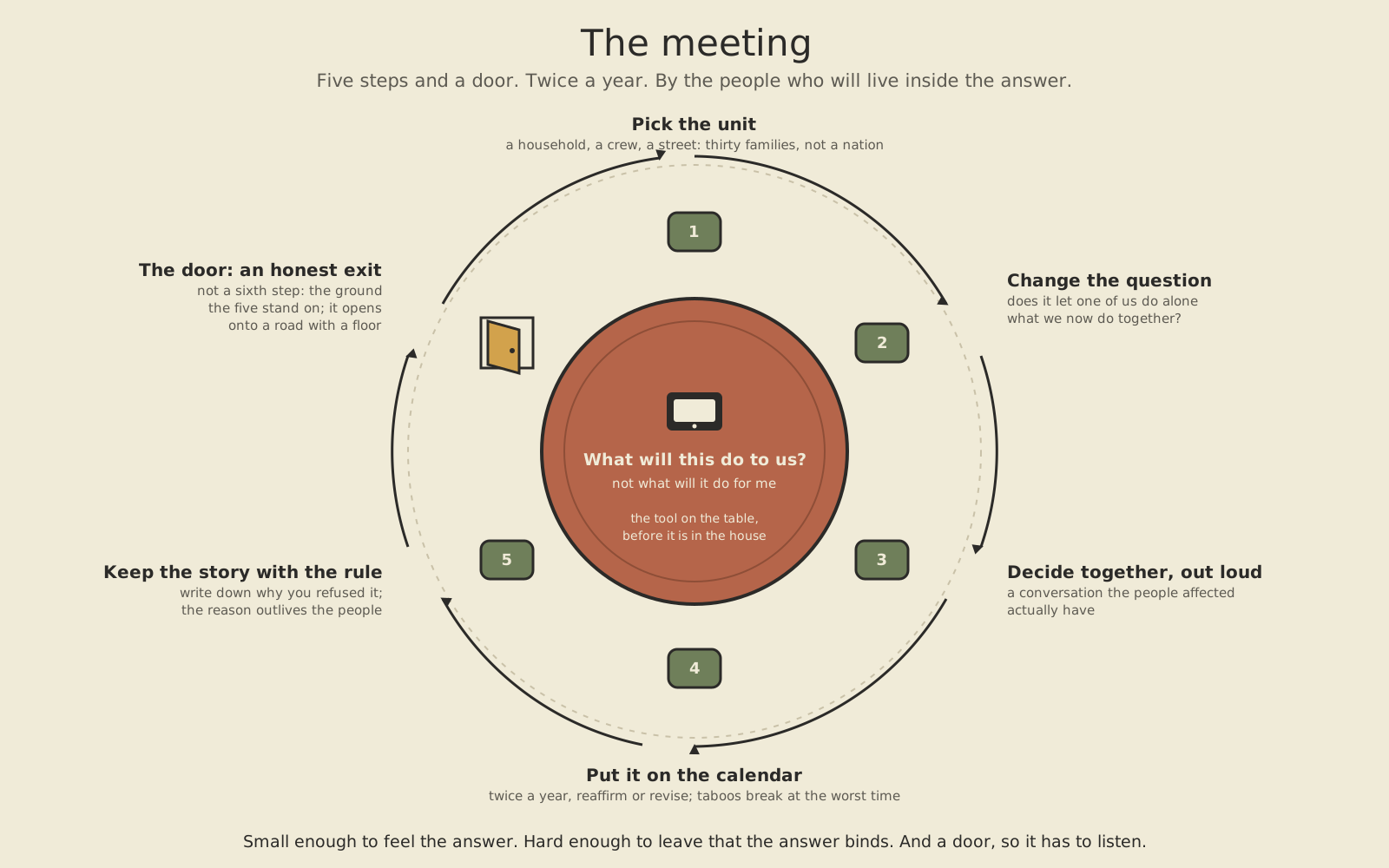
And put the next complex on that table first. It will not arrive as a refinery. It will arrive as a subscription, an assistant, a feed that already knows you, a system your employer or your school adopts without a meeting. Ask it the Ordnung's questions before it is in the house: what will this do to us, will it let one of us do alone what we now do together, does the wire run to the world. Then keep what is yours portable while it is still yours, your data in a format anyone can read, your contracts in your own name, your keys in your own hand, because a tool you cannot leave was never a tool you chose.
This is not a call to tear down the machine. It is a call to take back the one thing the machine took first: the decision about what it is allowed to do to us. The machine did not break our families or swell our government by decree, and it did not do it alone. What it did was make it unnecessary to ever ask, and that is the part we can take back. The families, the nations, and the church districts who still ask are not backward. They are running the meeting we cancelled.
The honest exit, and the road between doors
The door needs its own room, because both an individual and a republic get it wrong, and because the whole essay stands on it. A reader put the question exactly the way it should be put. In a SQUEIL world, or in any world where a people runs its own meeting, if I exit, do I still get the benefits of government? Do I still have to comply with its orders?
The short answer is that exit ends the government's administration of you, not your obligations to everyone else. The long answer takes the rest of this section, because the word "exit" is hiding three different things, and because the interesting part is not the door. It is the road between one door and the next, where in every earlier world a person simply disappeared.
Three exits hiding in one word
Exit from a program. This one is full. You stop being administered by it and you take your data with you. That is the SQUEIL right as written, and the Amish already run the civic version of it. Since 1965, self-employed Amish have been exempt from Social Security tax, and the deal is symmetrical: no tax, no check, ever. They do not take Medicare either. They pay the hospital in cash and cover each other through the church. Benefit and obligation travel together. If you exit the program, you exit the benefit. That is reciprocity, not punishment.
Exit from a jurisdiction. Only by leaving it, which is why the units have to be small. In SQUEIL terms, moving your estate to another tenant's rules; in civic terms, another district or state. Cheap exit between small units is the whole reason to keep them small.
Exit from the compact while standing inside it. No, and it should not be possible. This is the sovereign-citizen fantasy, and it fails in a SQUEIL world for the same reason it fails in this one: there is no exit from other people's rights. A tenant who leaves the platform still cannot defraud the tenants who stayed, and the constitution's common defense against fraud and abuse applies at the boundary. Laws of general application, fraud, assault, contract, the road you drive on, bind you because you are here, not because you signed up. Even the Amish do not claim otherwise. They pay income, property, and sales tax, including the school tax for schools they do not use, and when they refuse a rule, schooling past eighth grade or a slow-moving-vehicle sign, they do it through the courts and negotiate an exemption. They do not declare themselves outside the law.
What "landlord to counterparty" actually changes
If exit does not free you from the general law, what does the demotion of government from landlord to counterparty, the move I argued for in Same Skeleton, Swapped Organs, actually buy? The default, and the burden of proof.
Benefits become published contracts, not permissions. The state has to justify what it takes from you, on the record, with due process and a stated objective. You no longer have to justify what you keep. You can build the parallel thing, the school, the mutual-aid fund, the marketplace, without a permit.
And there is a deeper reason exit matters even when it is expensive. Exit is what makes voice credible. Albert Hirschman made the point in 1970: a meeting whose members can never leave does not have to listen; a meeting whose members can leave, at real cost, has to earn the answer. That is what "hard enough to leave that the answer binds" meant above, and it applies to a district exactly as it applies to a church.
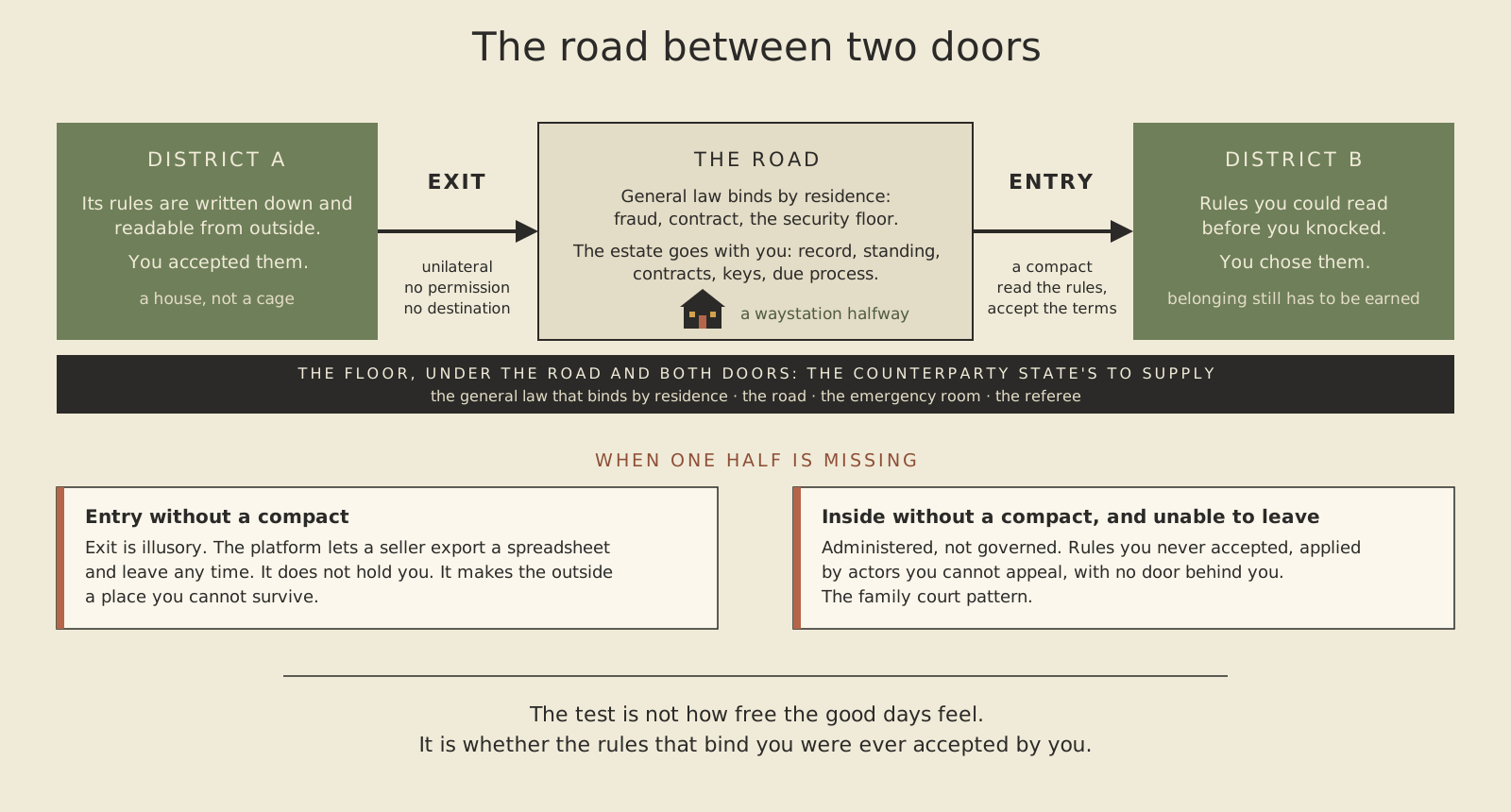
Exit is unilateral. Entry is a compact.
Does leaving require an accepted compact with another community first? No, and here the SQUEIL Constitution is more precise than most people's instincts.
The Right to Exit says no stakeholder may be held against their will, and that exit comes with full data portability, documented offboarding, and the immediate stop of any further action against your estate. Nothing there says a receiving platform has to accept you first. Exit is the escape hatch. Full Faith and Credit, which binds every tenant to honor every other tenant's records and standing, is a separate clause that governs how the ones who stay treat each other. Exit is unilateral. Entry is a compact.
The Amish are the exact parallel. When someone leaves a district, the district does not decide whether the person may go, and it does not ask where they are going. It decides only how it will treat them afterward. That is what shunning is: the community's answer to the leaver, not a lock on the door. Someone leaving Lancaster in 1970 walked into a world with no compact for them at all. They were English by nightfall, bound by the general law like everyone else, and free.
Which is the important part. Leaving one house does not put you in another house. It puts you outside, in the space governed by law that binds by residence rather than by membership. That is why the exit clauses of any constitution worth the name have to reach past the door: your estate has to be enforced against the outside as well as the inside. In SQUEIL you leave with keys that still work, an export in an open format, and standing that other tenants are bound to credit. That is what makes exit real rather than nominal.
The Amish and the nations teach one more thing here, and it is the line the whole argument turns on. Where entry requires a compact, exit is real: the Amish, or a tenant with a portable estate and a market of other platforms. Where entry does not require a compact, exit is illusory. Amazon will let a seller export a spreadsheet and leave any time; that is the platform's version of shunning. It does not hold you. It just makes the outside a place you cannot survive. And where you are inside without a compact and cannot leave, which is family court, you are being administered rather than governed. The test is not how free the good days feel. It is whether the rules that bind you were ever accepted by you.
The road
Between one door and the next you are on the road, and in every earlier world the road was where a person disappeared, because trust ran on membership. Outside your district no one would extend you credit, vouch for you, or hire you. The ex-Amish leaver's real problem in 1970 was not paperwork. It was that nobody knew him.
What changes, in an architecture built for exit, is that the estate persists when the membership ends. I will use the SQUEIL Constitution as the worked example, because it is the one I can point to clause by clause. Five things walk out the door with you.
Your record. Append-only. The community you left can add its verdict on you, but it cannot rewrite your history, and any correction has to be a new entry that points at the old one.
Your standing. Adjudicated by the Arbiter and credited by every other tenant. You arrive at the next door with a verifiable past instead of the old district's account of you, or nothing.
Your contracts. The platform is barred from impairing the obligations between a tenant and its customers, so leaving a community does not strip your livelihood. A cleaner who leaves one guild keeps his customers.
Your keys, and an open export. The estate is yours in fact, not just on paper.
Due process on the way out. No downgrade or recharacterization without notice, a hearing, and appeal. Shunning in SQUEIL can be a community's opinion on the record. It can never be an edit to the record.
Underneath all five, the federation's baseline still applies to an estate that belongs to no district: defense against fraud, the security floor, contract enforcement, continuity of the record itself. That is the general law of the road, and it is what makes trust without membership possible.
Three things the road still needs
The constitution gives you the estate. It does not spell out three things a road needs, and SQUEIL could add all three.
A legible market of districts. Because the Canon must be plain text, readable by everyone bound by it, you can read a community's rules before you leave your own and choose entry on terms you actually accept. That is the opposite of how people usually change churches, towns, or platforms, which is blind.
Waystations. Communities whose rules are explicitly temporary and low-commitment, built to receive estates between homes. The ex-Amish world already has these: support networks that provide a bed, a GED, a driver's license, and someone who knows the road. The 1750 version was the inn, hospitality to strangers under general law without membership. A federation of estates should have tenants whose whole purpose is the road.
The estate as a district of one. The constitution lets the Coronel function, the human veto, be delegated to a tenant within its own estate. A person on the road is not ungoverned. He is self-governing, which is different, and it means the meeting continues even when it is a meeting of one.
What the road cannot carry
Now the limits, because a road that promises too much is the machine again.
An architecture like this can make you verifiable to strangers. It cannot make you known to them. Belonging still has to be earned in the new room, by showing up, the way it always has.
It cannot force acceptance. Entry stays a compact, and a district that must take everyone is not a district.
And it does not by itself supply the floor. The gap between doors is precisely where the bottom rungs of the ladder are exposed: food, shelter, medicine. If nothing supplies that floor, exit is Amazon's exit, technically free and practically fatal, and the whole argument for a right to leave collapses into a right to starve. So I am going to pick, because an essay that hands the reader the hardest part has not finished. The floor is the counterparty state's to supply. That is what is left of a state once you demote it from landlord: the general law that binds by residence, the road, the emergency room, and the referee, and those four are the floor. The Amish leaver walks onto that floor the day he leaves; it is why he can leave. The Tokugawa village had it in the domain's law and granary. A federation of estates can add to it and mutual-aid tenants can thicken it, but the state owes it, and it owes it to the person on the road exactly as much as to the person in the house. A republic that will not supply the floor is not a small government. It is a landlord that has stopped repairing the building.
What the republic is to learn
I took the machine away to see the decision underneath it. We are not actually going to take it away, and the next complex is already forming inside it. AI is the fastest-moving, least-decided technology in history. Its data centers are being socialized onto the household meter the way the highways were socialized onto the household tax, and it is coming into every institution whether or not anyone asks what it will do to us. That is what makes it the next potential complex rather than the next tool: not the power of the thing, but the absence of a meeting.
So here is the republic's form of the question. How do you run the meeting when the tool on the table is AI, and the room is not thirty families but a city, a state, a republic?
Start by admitting what our current meeting is. Voting and petitioning are the machine's version of the Ordnung: rare, indirect, and unmeasured. You vote for a person, not for a goal. Nobody's job is tied to a stated objective you can check. Your petition goes into a system that, as I laid out in Same Skeleton, runs on the same five bones wherever you find it: actors shielded from the cost of failure, gatekeepers who write the rules they are graded by, standards nobody can define, money that pays for volume instead of outcomes, and a standing allergy to being measured. Push a petition into that skeleton and it does what the skeleton does. It converts your right into a permission and your permission into a wait.
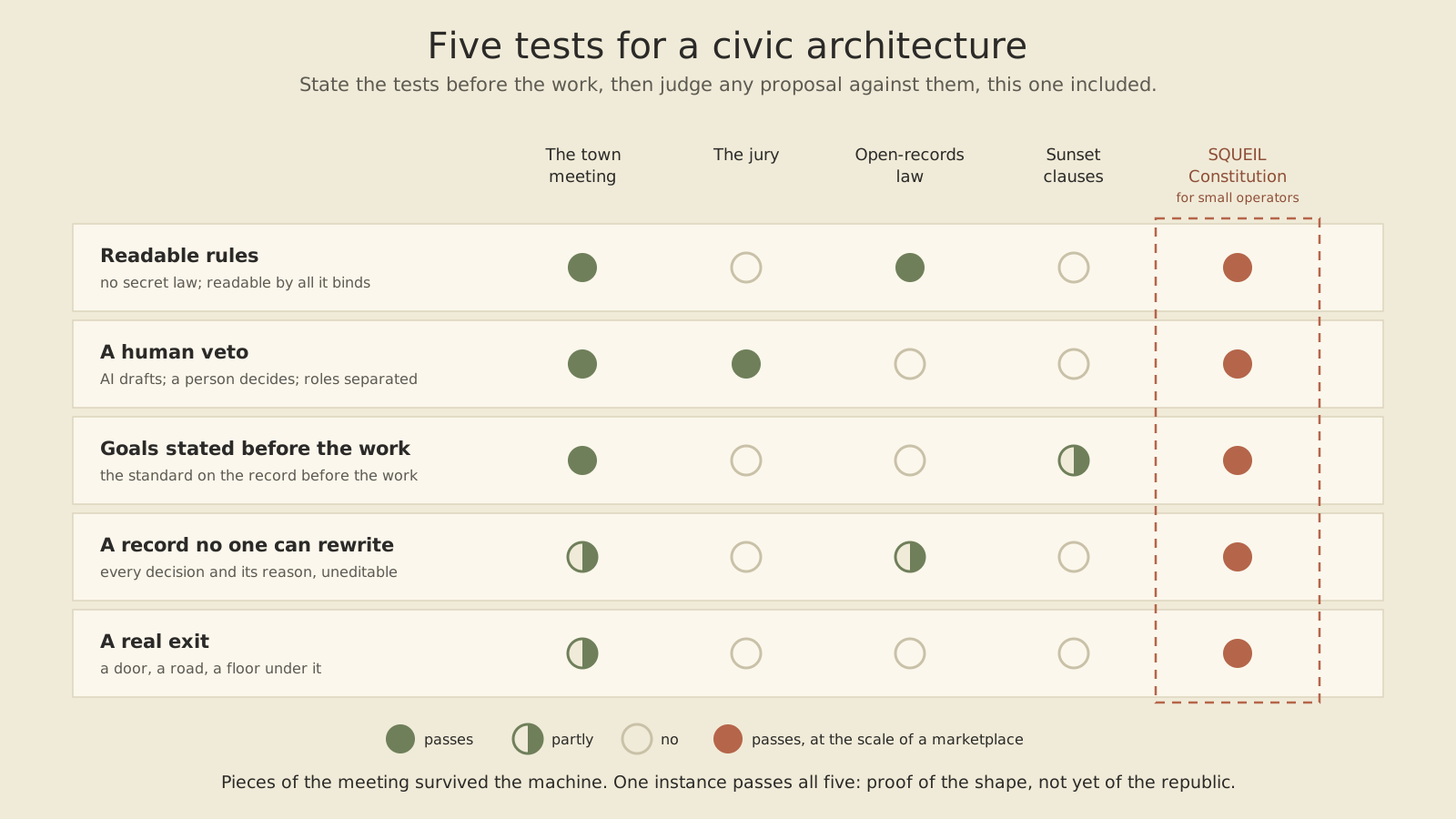
That is the machine's meeting. It is not the Amish meeting, and the difference is not sincerity. It is architecture. So state the architecture as tests, the way you would state a specification before the work, and judge any proposal against them, mine included.
Five tests. Readable rules: whatever governs the room is written in plain text and readable by everyone bound by it; no secret law. A human veto: AI drafts, sorts, routes, and remembers, and a person decides, with roles separated so the ones who write the goal are not the ones grading their own work. Goals stated before the work: the standard exists on the record before anything is done, so an office can be checked against the goal it accepted rather than against a wish list. A record no one can rewrite: every decision, every change, every reason, in a chain its authors cannot edit, because a shield only works in the dark. And a real exit: a door that opens onto a road with a floor under it, which is the whole previous section.
Now be fair about what already passes some of them, because none of this is new, and a republic that pretends it is will overbuild. The New England town meeting passes the first three: the warrant is published, the floor votes, and each article says what is to be done before it is done; its minutes are a record but not an unrewritable one, and its exit is the next town over. The jury passes the veto test better than anything else in the country: twelve people who decide, and who owe no one a reason. Open-records and open-meeting laws pass the readable-rules test and half of the record test. Sunset clauses pass half of the goals test, by forcing a law to restate its purpose or die. Each of these is a piece of the meeting that survived the machine. None of them passes all five, and the gaps between them are exactly where the five bones live.
One thing I know of passes all five, and I want to place it honestly. The SQUEIL Constitution is written for the tenants of a marketplace, small operators, and at that scale it does what the tests ask. The Canon is plain text and there is no secret law. The Coronel is a human gate with an absolute veto that needs no justification. Objectives are published before work and may not silently degrade. The record is append-only and cryptographically chained. Every stakeholder can leave with data, contracts, standing, and keys. That is proof of the shape. It is not yet proof of the republic, and I will not claim it is. Reading "tenant" as "town" is the right thought experiment, but a town has children in it and a marketplace does not, and the floor under a town is a state's job before it is a platform's. What the instance shows is that the tests can be met in code, and that a founder can bind himself first, which is the one thing every captured system refuses to do.
Put the tests together and a petition looks like this. A neighbor writes what she wants in her own words. AI helps her state it as a goal with a measure and a date. It goes on the record where everyone can read it. Her district votes on the goal and on the role that owns it, and the officeholder accepts the role in writing against the objective. Every action taken on it is logged where nobody can rebaseline it. The dashboard shows the status without anyone filing a records request. At the next meeting the room reaffirms, revises, or reassigns. And if the answer stays no, she can see exactly where and why, she can appeal to a referee that records its reasoning, and she can walk out onto a road with a floor and build the thing herself.
So, to the question in the title
What an individual is to learn from the next potential complex is that the meeting is his to run, at the scale where he lives, and that the question is never what the tool does for him but what it does to the people he is bound to. Put the next complex on the table before it is in the house. Know which exit you are taking before you take it: a program, a place, or the compact, because only the first two exist. And keep your estate portable now, while you are still inside: your data in a format anyone can read, your contracts in your own name, your keys in your own hand. Exit is not something you exercise on the day you leave. It is something you have or do not have on the day you decide to.
What a republic is to learn is that its meeting has to be rebuilt in architecture rather than in sincerity, and that the architecture can be stated as five tests and judged against them: readable rules, a human veto, goals before the work, a record no one can rewrite, and a door that opens onto a road with a floor. Pieces of that survived the machine and are already ours: the town meeting, the jury, the open record. One instance passes all five at the scale of a marketplace, which proves the shape and not the republic. And the floor under the road is the republic's own to supply, because that is what a state is for once it stops being a landlord. Neither of these lessons is a way to keep AI out. Both are the way to keep it from becoming a complex, which is what every technology becomes when no one has to decide.
Which is where the whole essay lands. Life, liberty, and the pursuit of happiness are, in Maslow's terms, the ladder. Life is the bottom rungs, the food and the medicine and the famine relief, and the machine served those better than anything before it. Keep them. Liberty is sovereignty, not permission, and it is exactly what the machine took when it made the deciding unnecessary. Take it back by owning the record and the decision. The pursuit of happiness is the top of the ladder, belonging and esteem and becoming, and it is what the machine hollowed out. It comes back the only way it ever has: in a room small enough to feel the answer, deciding together, out loud, again.
The peoples who take their time deciding about technology are not showing us how to live without it. They are showing us how to keep the meeting when a powerful tool comes into the house, and that every meeting worth keeping sat inside something larger that supplied a floor and a door. AI is the most powerful tool that will ever come into ours. Put it on the table.
Exit is what makes voice credible. The road is what makes exit real. Build the road, and the meeting will listen.
Not the oil, in the end. Not the machine. The meeting, and the road between meetings.