Why I Chose the Mascots of a Turtle and Robin for SQUEIL
A founder's letter on rebirth, wisdom, and the symbols American commerce needs now
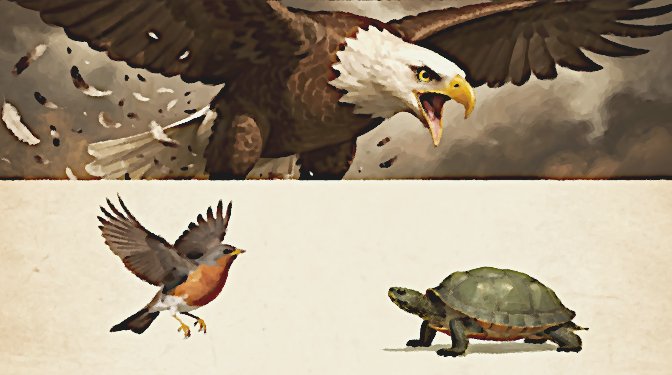
This started in a conversation. Founder and machine, turning over an old letter from Benjamin Franklin and a question about what kind of country still wants to be the bird on its seal. The symbols below came out of that exchange — and so, in many ways, did SQUEIL.
The Bird on the Seal
When Benjamin Franklin wrote to his daughter in 1784, he confessed his disappointment with the eagle. "A Bird of bad moral Character," he called it. Lazy. A bully. A scavenger that lets smaller, more honest birds catch the fish — and then swoops in to rob them. He preferred the turkey, "a Bird of Courage," and though he never formally proposed it for the Great Seal, his letter has outlasted most of what was actually decided that year.
I think Franklin saw something we have spent two and a half centuries trying not to see.
The eagle is borrowed plumage. Rome wore it. Napoleon wore it. The Habsburgs, the Reich, every empire that ever wanted to project force from altitude wore it. To take it as a symbol is to inherit that posture: strike from height, seize rather than harvest, mistake altitude for authority.
The eagle takes. It does not tend.
For most of American history, that posture worked, because there was always more frontier — more land, more market, more attention, more credit, more trust. An eagle is at home in abundance. It is a symbol for systems that can afford to be predatory because the prey is replenishing on its own.
We don't live in that country anymore.
We live in the ruins of an extractive consensus. Small businesses have been swallowed by platforms that resell their own inventory back to them at a margin. Independent labor has been disintermediated by aggregators who own neither the trucks nor the trades. Marketplaces have quietly become protection rackets. Commerce in America does not need another eagle.
It needs a way to come home.
So when it came time to choose the mascots for SQUEIL, I refused the predator on the seal. I chose two smaller, humbler creatures — and I chose them on purpose.
I chose the robin. And I chose the painted turtle.
MASCOT ONE
The Robin: Rebirth

The robin is the herald of return. It is the first bird back to a yard after winter — the one whose song breaks a season the rest of the field is still waiting out. In Christian tradition, its red breast is wounded service: thorns pulled from the crown, blood given for warmth in the manger. It does not dominate the sky. It tends a yard.
Commerce in America needs that posture. Not conquest. Return.
The robin builds carefully. It raises young. It comes back. It signals — to anyone willing to listen — that something the rest of the field had given up for dead is alive again. That is what SQUEIL is meant to do for the small operator, the local provider, the trade that built this country with its hands and then got priced out of the market it built.
I am not here to win the platform war. I am here to bring something home.
Rebirth is not a soft word. Rebirth is what comes after death — and a great deal of what made American commerce honest has died. The robin's job is to sing through the cold long enough for the rest of the field to remember that spring is real.
MASCOT TWO
The Painted Turtle: Wisdom

The turtle is older than the eagle. Older than Rome. Older than the flag.
In the cosmology of the people who lived on this continent before any flag flew over it, North America itself is Turtle Island — the land rests on a great turtle's back. The eagle is found everywhere on earth. The painted turtle is genuinely here. It is native in a way the eagle never was.
The turtle carries its home. It defends without attacking. It lives long enough to remember. It moves slow enough to be sure. Where the eagle's authority comes from altitude, the turtle's comes from endurance — from having seen enough seasons to know which ones repeat and which ones break new ground.
This is sovereignty in its truest form: not the right to dominate from above, but the capacity to carry what is yours, on your own back, wherever you need to go.
A sovereign business does not depend on a platform's permission to exist. A sovereign provider does not have to ask the aggregator for the customer it earned. A sovereign marketplace does not extract from the very people it claims to serve.
That is what the painted turtle teaches. Wisdom is not knowing more. Wisdom is carrying less that is not yours, and more of what is.
Rebirth Through Wisdom
Put them together and you have the founding posture of SQUEIL.
This is not a marketing aesthetic. It is an architectural commitment.
Every decision SQUEIL makes — about who keeps the data, who owns the customer relationship, who carries the cost of the platform, who gets paid first and how much — flows from this posture. We do not build like the eagle. We build like the robin and the turtle.
And because this is the age of intelligence built in software, every agent we name and every line of code we write carries the same disposition. Our systems must be turtles — carrying their own home, defending without predating, never depending on another's permission to exist. Our systems must be robins — tending, returning, singing through cold seasons to a field that has forgotten what spring sounds like.
Rebirth without wisdom is just another bubble. Wisdom without rebirth is just nostalgia. American commerce needs both, and it needs them together.
Franklin was right about the eagle. He was just three centuries early.
The robin is back in the yard. The turtle has not moved from this ground in ten thousand years. Between them, they carry the country home.
Legal Notice & Disclaimer
Editorial Opinion and Commentary. This essay is a work of editorial commentary and personal reflection. The arguments, characterizations, and conclusions expressed herein are the personal opinions of the author, Patrick Roden, in his individual capacity. They do not necessarily represent the formal positions of On Top Home Services LLC, DevForge Academy, or any affiliated entity. Reasonable readers may disagree with any or all of the views expressed.
Religious, Cultural, and Civic Commentary. Statements in this essay regarding faith, family, gender, marriage, parenthood, civic life, and the role of cultural institutions reflect the author's personal beliefs and lived perspective. They are offered as one person's account, not as universal claims about how anyone else should live, believe, or order their household. Readers of all backgrounds, traditions, and family structures are welcomed; nothing in this essay is intended to disparage any person, group, or family configuration.
No Defamation Intended. This essay critiques structures, systems, and patterns — not specifically named individuals. References to general categories of actors are categorical descriptions and are not directed at, and should not be understood to refer to, any specific identifiable person or organization. No statement in this essay is intended to assert or imply that any specific identified individual or organization has engaged in unlawful, unethical, or fraudulent conduct.
Forward-Looking Statements; SQUEIL. Statements about the design, intent, or future capabilities of SQUEIL, DevForge Academy, On Top Home Services LLC, or any affiliated venture are forward-looking and reflect current architectural and operational intent. Actual implementation, capabilities, terms, and protections will be governed by the definitive operating agreements, terms of service, privacy policy, and constitutional documents in effect at the time any tenant, implementer, customer, student, or stakeholder enters a relationship with the relevant entity. Forward-looking statements involve risks and uncertainties; nothing in this essay should be relied upon as a guarantee of future outcomes.
Not an Offer or Solicitation. This essay does not constitute an offer to sell, or a solicitation of an offer to buy, any security, equity interest, token, membership unit, subscription, or other financial instrument in On Top Home Services LLC, DevForge Academy, or any affiliated entity. Any such offer or solicitation will be made only by means of definitive offering documents and only to qualified persons in compliance with applicable federal and state securities laws.
Not Legal, Financial, or Investment Advice. Nothing in this essay constitutes legal, tax, financial, accounting, or investment advice. Readers should consult their own qualified professional advisors before making any decision based on the views or information contained herein.
Trademarks. SQUEIL™, the Coronel, the SPEED Methodology, Canon, Forge, Arbiter, Worker, and the Sovereign Tribune are marks and architectural designations of Patrick Roden AI, a DBA of On Top Home Services LLC. On Top Home Services is a registered Oregon LLC (CCB #244467). Other marks referenced are the property of their respective owners and are used for descriptive and comparative purposes only.
Affiliation. DevForge Academy is a venture of the same founder as SQUEIL and On Top Home Services LLC. The author is affiliated with each of the ventures named here and writes about them as an interested party, not as a disinterested observer.
Copyright. © 2026 Patrick Roden. All rights reserved. The text of this essay (excluding quoted, attributed, or referenced third-party material) is the original work of the author. Brief quotation with attribution is welcomed; substantial reproduction or redistribution requires written permission.