
It was late. Three terminals open, a Supabase dashboard in another tab, Claude Code chewing through migration files, and a second Claude surfacing new rabbit holes every few minutes. I was deep in Sprint 3 of a 24-sprint plan, trying to close out a governance retrofit that — if I’m being honest — most founders would have just shrugged at.
That shrug is where a lot of systems quietly die.
Here are the two things that session clarified for me.
1. AI will fall short. The question is whether your system catches it.

Somewhere in that late-night session, the AI I was working with hallucinated a migration file that didn’t exist. A little later, it deferred a scope item to “my mental list” after I’d explicitly asked it to log everything to the tracker. A little after that, it let a co-author attribution slide by on a commit without flagging it.
None of those are catastrophic. Each one, on its own, is the kind of thing you could easily miss.
Here’s what I want builders working with AI to actually internalize: AI is going to fall short. It’s going to invent things, skip things, let small inconsistencies slide. That is not a bug you’re going to prompt your way out of. It’s a property of the tooling at this moment in time.
The instinct didn’t come from AI. It came from ten years as a BA.
I didn’t invent my response to drift while building SQUEIL. I built it over ten years as a CBAP-certified business analyst, watching what happens when foundational requirements drift gets discovered in production instead of in the requirements phase. Every BA alive has lived the 1:10:100 rule — the cost of a defect roughly multiplies by ten with every phase it escapes into.
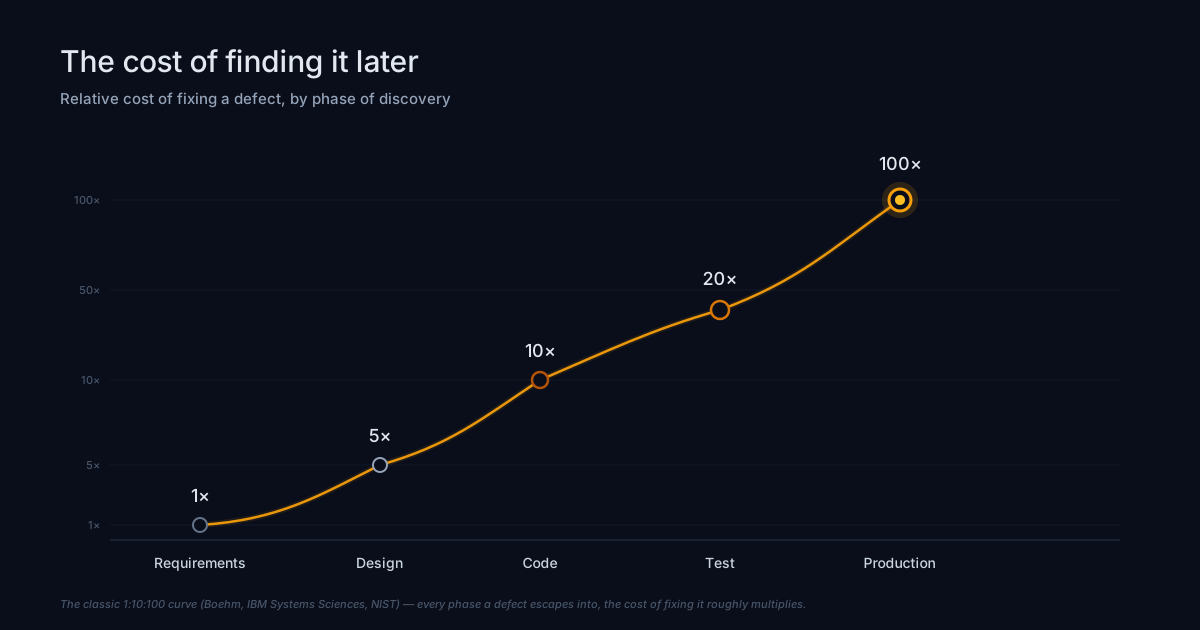
I’ve paid the rightmost column of that curve more times than I want to count. A misunderstood requirement that survived into production. A design assumption nobody surfaced until integration test. A validation rule skipped in a sprint that took three weeks to undo six months later. The pain of the right side of that curve is exactly what makes the left side feel cheap.
So when AI-assisted development came along, I didn’t have to invent the instinct to catch drift early. I just had to refuse to unlearn it.
The governance framework I’ve been building around SQUEIL — the CODEX, the governance records, the drift checks, the compliance gates — exists for exactly this reason. Not because I distrust AI. Because I know AI will drift, and I want the drift caught in the same loop, not three sprints later when a phantom migration file is the reason production won’t deploy.
The test isn’t “does your AI get it right most of the time?” Of course it does. The test is: when your AI gets it wrong, does your process notice?
That’s the thing. Everything else is marketing.
2. Treat your own ventures like your life depends on it - because it does.
When leaving the corporate world, and being accustomed to a certain lifestyle - it can be very challenging to get the cashflow that you once had. Furthermore, the risk and mountain ahead can be enough to deter very capable and determined people. Many fail and do not make it. What I have come to realize - is that I will not accept failure and I will work as hard and smart as I have to, because I have no other choice. I’ve noticed something though - If I keep pushing in a direction; the right people will show up - but sifting through all the wrong ones takes a special kind of discipline. Faith over fear and God’s hand will get me through.
When drift showed up in that session — a missing migration, a stale index, a phantom Supabase ref, hidden staged files — my instinct was to expand the scope of what I was fixing, not contract it. That instinct is not natural. Every other signal in the moment says to cut, close the ticket, go to bed.
The only reason I had the instinct at all is because I’d decided, earlier and in writing, that the cost of closing the gap now was much lower than the cost of discovering it at scale.
That’s the curve again. Left side or right side. Pay a little now or a lot later.
A consultant optimizes for the engagement. A founder optimizes for the system that outlasts the engagement. That’s a founder decision, not a consultant decision — and it’s the one I spent a decade of BA work learning to make reflexively.
The second lesson, then: if you’re building anything you want to survive your own attention, start treating your own ventures with the kind of care you’d reserve for a client paying you $400 an hour. Not because the work deserves more ceremony. Because the work deserves the version of you that wouldn’t let things slide.
The close
The session ended the way a good session ends — not with everything perfect, but with the system in a more rigorous state than when we started. The drift was caught. The governance records were updated. The specific AI failures were logged and addressed, not glossed over. The commit attribution was corrected.
None of that happened because the AI was flawless. It happened because the framework and process I created - caught the places the AI fell short, and because I’d built a habit — over a decade and many rightmost-column battle scars — of holding my own ventures to the standard I’d enforce on any paying client.
If you’re building with AI right now, those are the two muscles worth training. Build a system that catches drift; trust in a higher power of good faith. Hold your own work to the standard you’d hold someone else’s.
The rest is execution.